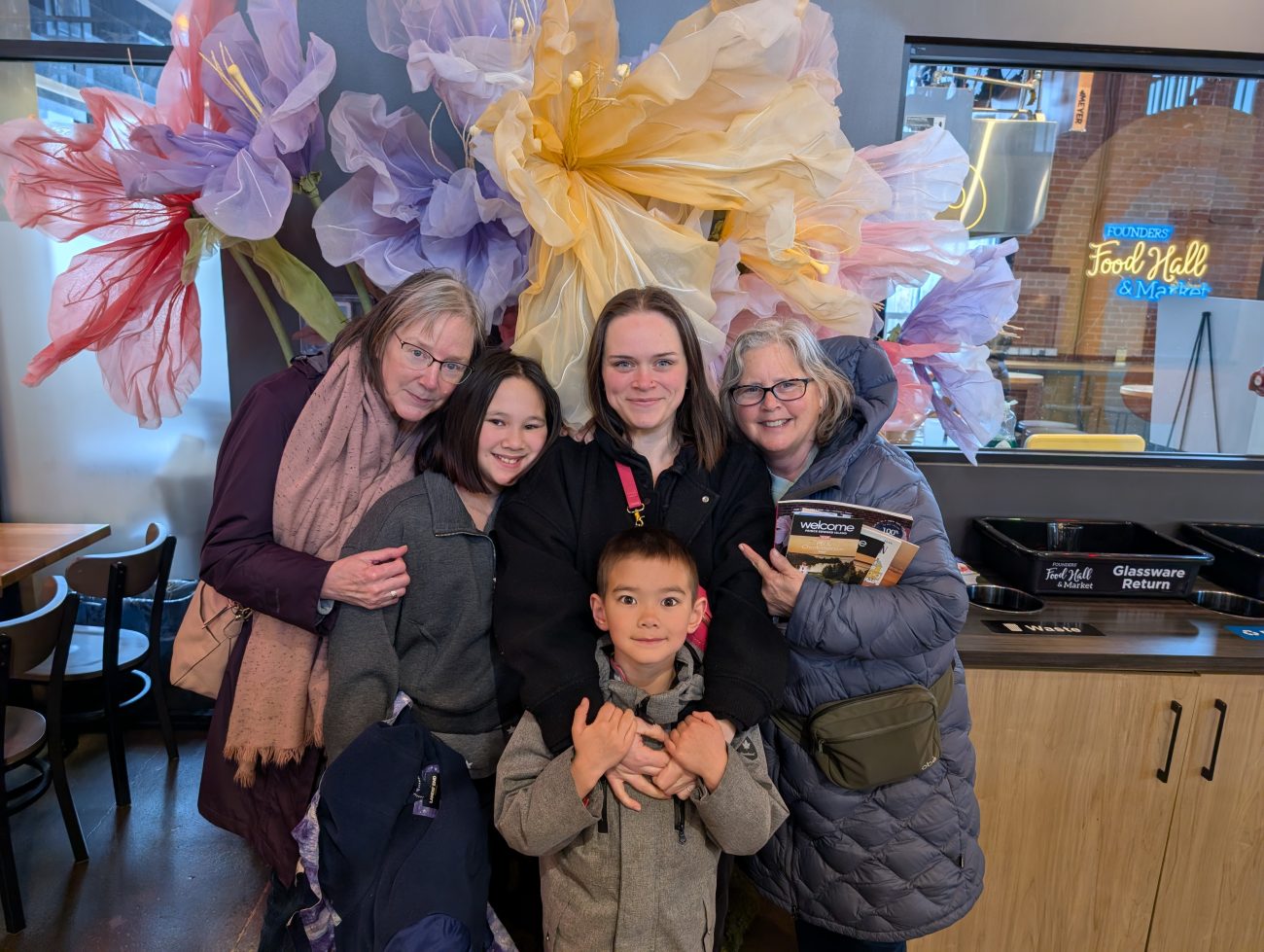
Image: My mom, me, my aunt, and my kids… we all seem to be aging.
Eight years ago, I cried in a parking lot.
Okay, I have cried in a parking lot a lot of times since then, but at that time, it was because I’d just been told I had gestational diabetes. My son was still months from being born, and I was sitting in my car trying to process what that meant…a needle every night to regulate my overnight hormones, a complete overhaul of how I ate, and a quiet, creeping fear that I had done something to mess up my body in ways I couldn’t undo. I had to fix it… for my son.
When he arrived, the diabetes went away. But the fear didn’t, not entirely. I didn’t want to spend the rest of my life managing a condition that felt, at least in part, preventable. So I made one small change. Then another. Then another. Over the last three and a half years, those changes quietly added up to losing 152 lbs, my A1C down from pre-diabetic to the lower end of normal, and all other important markers (cholesterol, vitamins, iron stores, kidney function) being perfect across the board.
I am not telling you this as a weight loss story. I am telling you this because it was the first time I had evidence that the body is a system, and that systems respond, slowly, non-linearly, sometimes in ways you don’t notice until suddenly you do.
I study systems for a living. Ecological economics, community well-being, the slow metabolisms of rural places trying to sustain themselves. I think a lot about what makes systems resilient, what they need to function, what happens when you extract too much from them for too long.
I have spent considerably less time applying any of that to myself.
That changed recently when my doctor gave me the most unsexy piece of medical advice I have ever received: sit on the edge of the bed for thirty seconds before you stand up. Hydrate immediately. My body, it turns out, despite all the numbers being good, needs a buffer period now. A phase transition. It no longer tolerates the kind of instantaneous, on-demand output it once did.
I found this both annoying and clarifying in equal measure.
The Great Pruning
In ecological economics, we talk about degrowth not as collapse, but as intentional contraction; shedding what isn’t working to protect what is. A healthy forest prunes itself. So do healthy organizations, healthy communities, healthy people.
I am in a pruning phase.
This year, I made a decision to redefine which projects I lead and which ones I hand to someone better positioned to carry them. I am closing my laptop at 4:30. I have taken work off my phone. I am booking whole weeks where I don’t schedule meetings. I am no longer treating uninterrupted time as a luxury, it’s a condition of doing good work.
I am also leaving my desk more. One thing the research keeps telling me, and that I keep learning in practice, is that the most important things happen in community, not in front of a screen. So I’m going out into the world more. Sitting with people and listening to the endless stream of interesting stories.
Does it feel like letting people down? Honestly, yes, sometimes. There is a particular kind of guilt that academic women carry around saying no, and I am not immune to it. But mostly, what this pruning feels like is relief. Like weight coming off my shoulders…slowly, one small change at a time, the same way it came off everywhere else.
A Framework I’m Still Building
The more I research aging and well-being, the more I find myself turning the lens inward and asking: what would I tell a community trying to sustain itself? What questions would I ask?
And then: why am I not asking those questions about my own life?
After talking about all this with my colleague and very good friend, I’ve started drafting what I’m tentatively calling a personal sustainability check… a short set of questions I can return to when I’m deciding whether to take something on, let something go, or just keep going. It’s a work in progress, but here’s where it sits right now:
| Question | What it’s really asking |
|---|---|
| Do I actually want to do this? | Not “should I,” not “could I” – want. |
| Does this align with what I’ve decided matters? | Is it in my research priorities, my values, my actual life? |
| What does this cost and is that cost worth it? | Time, energy, attention, health. All of it. |
| Who benefits if I say yes? | And is that a good enough reason? |
| What happens if I say no? | Usually less than I fear. |
| Is the stress proportionate to the meaning? | If the answer is no, that’s information. |
I don’t always have clean answers. But asking the questions helps.
I am on the brink of 40, I have two kids, I have a job I love that could easily eat my entire life if I let it, and I have blood work that is, for the first time in years, genuinely perfect.
I am trying to treat all of that with the same care. The body keeps the score, as they say. But so does the calendar, the inbox, and the list of things you said yes to when you meant no. Systems don’t lie, they just show you, eventually, the impacts of what you’ve been putting in.
Eight years ago, I cried in a parking lot because my body sent me a VERY clear message I couldn’t ignore about what it was being fuelled with. So now, I’m listening before it gets loud again. Both physically and mentally.
